Devil Tarot Card Meaning - 35 Interpretations!
Let’s get one thing out of the way: the scariest card in the deck is mostly bluff.
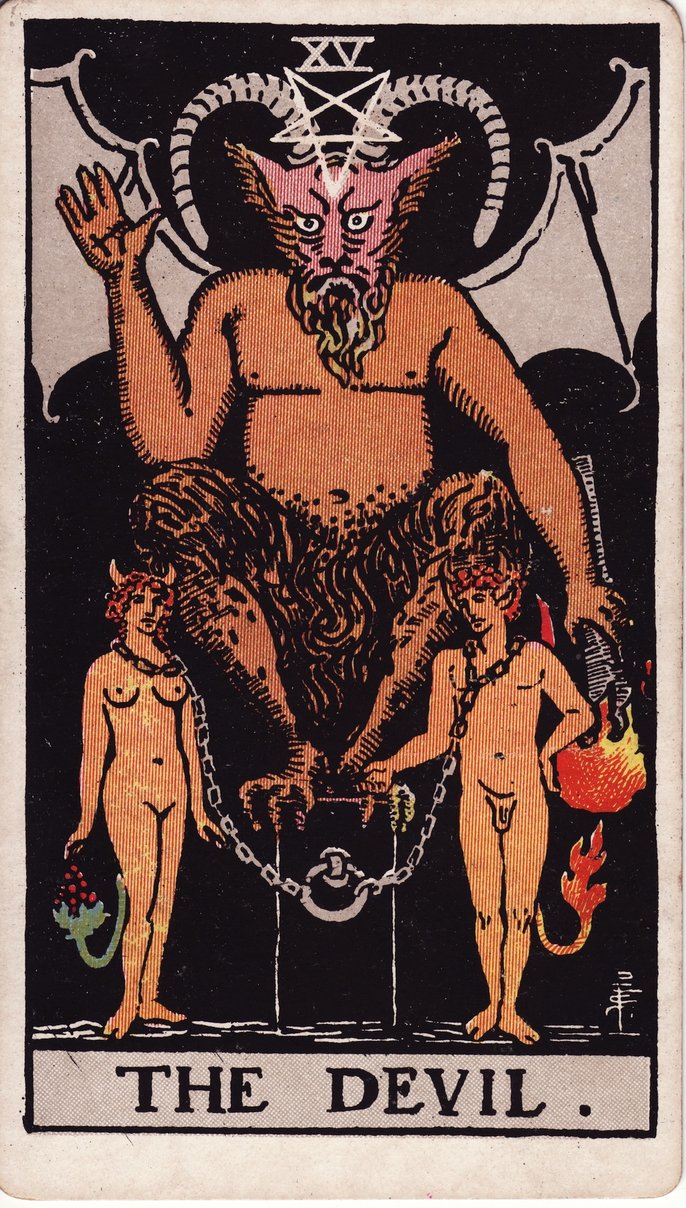
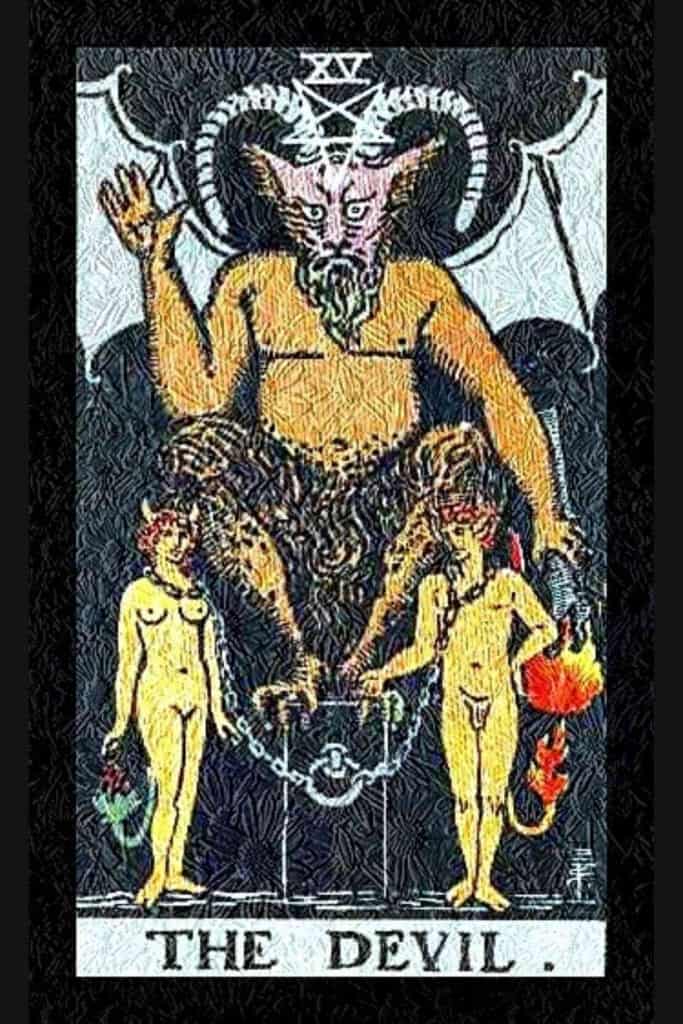
The Devil sits at number fifteen in the Major Arcana, and in the Rider-Waite deck he is doing his very best to intimidate you. A hulking figure with the horns of a ram, the wings of a bat, and the taloned feet of a bird of prey squats on a black half-cube of a plinth. An inverted pentagram is stamped on his forehead. His right hand is raised in a mockery of a blessing, and his left hand points a burning torch straight down at the earth, light aimed away from heaven, wisdom used to inflame appetite instead of illuminate it.
Arthur Edward Waite borrowed the figure from Eliphas Levi’s famous drawing of Baphomet, the goat-headed idol of nineteenth-century occult lore. But the two small figures below him are the real story. A naked man and woman stand chained to the plinth, sprouting little horns and tails, hers tipped with fruit, his tipped with flame. They are Adam and Eve gone feral. In fact, the whole card is a deliberate dark mirror of the Lovers: same couple, same central figure looming above them, but the angel has been swapped for a beast and paradise for a black void.
Now look closely at the chains, because everything hinges on them.
They hang loose. The loops around the couple’s necks are wide enough to lift off with two hands and a moment of decision. Nobody is holding them down. The Devil isn’t even looking at them. They stay because they have stopped checking whether they can leave.
That is this card’s entire teaching, compressed into one detail most people never notice. The Devil is not about some external monster ruining your life. He is about the cage you built yourself, furnished comfortably, and now call home. The habit you swear you could quit anytime. The relationship running on chemistry and dread. The job that pays just enough to keep you from asking what you actually want. The phone at 1 a.m.
The Devil’s only real power is convincing you the chain is welded shut. It never is.
This card rules appetite, obsession, materialism, addiction, and the shadow side you would rather not introduce at parties. It is uncomfortable to pull and genuinely useful to understand, because the moment you can name your chain, you can lift it. This guide walks through every position and context so you know exactly which chain the card is pointing at.
What does The Devil Tarot card mean?
Upright, the Devil means bondage you have agreed to.
Somewhere in your life there is a thing that promised pleasure and now collects rent. It might be a substance, a screen, a person, a paycheck, a grudge, or a fantasy. Whatever it is, the arrangement has quietly inverted: it used to serve you, and now you serve it. The card shows up to tell you the lease is still in your name.
The Devil rules the material world at its stickiest, the point where enjoying things curdles into needing them. There is nothing wrong with pleasure, money, desire, or ambition. The Devil is what happens when any of them stops being a choice. Think of the subscription you keep meaning to cancel, except the subscription is a behavior and the fee is your peace of mind.
This card also governs obsession and intrusive fixation, the loop your mind runs when it should be sleeping. And it governs self-deception, because no chain stays on without a story. “I deserve this.” “I’ll stop after this week.” “It’s not that bad.” The Devil is a fluent ghostwriter of excuses, and his best work sounds exactly like your own voice.
Here is the honest part, though. When this card appears, it is not a curse. It is a mirror held up at close range, and mirrors only show what is already there. The torch in the Devil’s hand still gives light, even pointed downward. Pulling this card means you are being shown the mechanism of your trap while there is still time to work the latch. That is not doom. That is intelligence you can use.
Ask yourself the one question the Devil hates: what do I pretend I cannot quit?
The Devil card Keywords:
- Bondage
- Addiction
- Attachment
- Obsession
- Materialism
- Temptation
- Codependency
- Overindulgence
- Lust
- The shadow self
- Self-deception
- Feeling trapped
- Unhealthy patterns
- Loose chains
What does The Devil mean when Reversed?
Reversed, the Devil is the sound of a chain hitting the floor.
This is one of the rare cards that often improves upside down. The reversal shows the moment of waking: you catch your own reflection mid-scroll, mid-pour, mid-text to the person you promised yourself you were done with, and something in you finally says, out loud, “what am I doing?” That flash of clarity is the whole card. Awareness is the hand on the chain.
The reversed Devil marks detachment, recovery, and the early stages of getting free. Early is the operative word. Waking up is not the same as being out, and the card is honest about that. The habit will call. The person will text, and they will text on the exact night your resolve is thinnest, because that is how patterns defend themselves. Expect the pull to get louder right as you reach the door. That is not a sign you are failing. It is a sign the exit is real.
There is a second, richer layer here too. The Devil reversed can mean reclaiming the healthy parts of what he rules: desire without shame, ambition without servitude, pleasure that you own instead of the other way around. Carl Jung would call it integrating the shadow. You stop pretending you have no appetite, and in exchange your appetite stops running the show from the basement.
One warning, offered with love: the reversed Devil can occasionally mean the opposite, a denial so deep you cannot feel the chain at all. If you pulled this card and immediately thought “well, this one isn’t about me,” sit with that for a minute.
The Devil Reversed Keywords:
- Release
- Waking up
- Breaking chains
- Recovery
- Detachment
- Reclaiming power
- Facing the shadow
- Independence
- Freedom of choice
- Healthy desire
- Self-awareness
- The exit in sight
The Devil as How Someone (He/She) Sees You
Buckle up: this person finds you magnetic, and not in the calm way.
When the Devil describes how someone sees you, you are the thing they think about when they should be doing something else. There is fascination here, heat, a pull they may resent even as they follow it. You are the notification they cannot mute. Whether that flatters you or unsettles you says a lot about what you want from them.
Be clear-eyed about the flavor of this attention. The Devil’s gaze is appetite before it is appreciation. They may see the surface of you in high definition and the substance of you not at all. Some people will cast you as their temptation, their bad influence, their beautiful mistake, and that role comes with excellent lighting and no respect.
There is also a harsher possibility worth naming: the Devil can mark you as someone’s scapegoat. If this person has been assigning you the blame for their own choices, treating you as the reason they can’t be better, that is their shadow wearing your face. You are not obligated to play the part.
The Devil Reversed as How Someone (He/She) Sees You
Reversed, the fever around you has broken, and what is left is more interesting.
This person is starting to see you as an actual human being rather than a craving with a face. If the connection between you was once obsessive or charged with drama, they now notice the change in you, and it registers. They see someone lifting chains off, someone who has looked at their own worst habits without flinching. Quiet transformations are not actually quiet; people watch.
Some of that watching is admiration. A person walking out of their own trap is magnetic in a completely different way than the upright card, the way an open door is magnetic to someone still sitting in a cage.
One caveat: if this person preferred the old you, the chained version who kept them company in the dark, your freedom may read to them as betrayal. That reaction tells you everything about what the friendship was for.
What does The Devil mean in Love?
In a love reading, the Devil asks one blunt question: is this love, or is it a habit with a heartbeat?
Upright, this card points to a bond running on intensity rather than intimacy. The chemistry is real, possibly spectacular. The Devil rules exactly that kind of gravitational attraction, and he would like you to notice that gravity is also what makes things fall. If your relationship cycles through the same fight, the same rupture, the same feverish reunion, that loop is the chain on the card. You are not close because you keep coming back. You keep coming back because the loop is comfortable and the exit is unfamiliar.
The card often flags codependency: two people managing each other’s moods instead of loving each other’s selves, staying because leaving feels like amputation. It can also mark a relationship where desire has crowded out everything else, all spark and no daylight, great at midnight and silent at breakfast.
If you are single, the Devil usually describes a pattern rather than a person. The same type, the same arc, the same ending, a playlist on repeat that you keep calling fate. It can also point to a fixation on someone unavailable, where the wanting itself has become the relationship.
None of this says run. It says look. Mapping the dynamic honestly with one of the best tarot spreads for relationships will show you whether there is a real bond underneath the fever. Sometimes there is. But the Lovers and the Devil feature the same couple, and only one of those cards has an angel in it. The difference is whether both people are free to stay, or just unable to leave.
What does The Devil Reversed mean in Love?
Reversed in love, the shackles are coming off, and this is genuinely good news with homework attached.
If you have been in a heavy, consuming, on-again-off-again entanglement, this card marks the turn: the spell thinning, the fog lifting, one or both of you choosing clarity over the next dramatic reunion. Sometimes that means the relationship ends, and you get your own mind back like a returned deposit. Sometimes, and this is the better story, it means the relationship survives its own toxin. The obsession burns off and what remains is two people who actually like each other, building something with load-bearing walls instead of fireworks.
Expect withdrawal either way. A charged bond leaves an ache when it quiets, and you may catch yourself missing the chaos and mistaking that for missing the person. Don’t renegotiate with the old pattern just because Tuesday was boring. Boring is what safety feels like before you’re used to it.
For singles, the reversed Devil is quietly lovely: an old fixation finally releasing its grip, an ex losing their haunting privileges, a pattern you have broken by seeing it. It can also mean making peace with your own desire, wanting what you want without shame and without letting it drive. That self-possession is the most attractive thing on this entire card.
What does The Devil mean in Friendship?
In friendship, the Devil points to the friend your best self would not choose.
Every friend group has its gravitational habits, and some friendships are built entirely out of one shared vice. The friend you only drink with. The friend you only gossip with. The one who greets your growth with “you’ve changed” as an accusation. The Devil asks you to check which of your friendships are bonds and which are just mutual enabling with inside jokes.
This card can also flag a transactional dynamic: someone who keeps you around for what you provide, whose warmth tracks suspiciously well with what they need that week. The Devil does not really do friendship; he does followers, audiences, and supply lines. If reciprocity has been feeling one-directional, the card is confirming your instinct.
Gentler and just as common: a friendship where you bring out each other’s worst on purpose, because misery loves a co-host. Two people can hold each other’s chains with complete affection. It is still a chain.
And if a friend of yours is genuinely struggling with an addiction, the Devil may simply be pointing there. That is not a cue to judge them. It is a cue to be the one person in their life who tells the truth kindly.
What does The Devil Reversed mean in Friendship?
Reversed, a friendship is getting free of what it was stuck in, or you are getting free of the friendship.
The best version: you and a friend outgrow a shared rut together. The habit that glued you, the complaining, the partying, the mutual wallowing, loses its charge, and you discover there was a real friendship underneath the whole time. Those are the people you keep for decades, the ones who can survive both of you getting healthier.
The other version: the friendship was the chain, and you are lifting it off. Walking away from a long friendship feels like a moral failure in a way romantic breakups don’t, and it isn’t one. Some connections are subscriptions to a person you used to be. Cancelling is allowed.
This card can also mark the end of a feud or a toxic group dynamic, old resentments finally dropped because carrying them cost more than they paid. Either way, the reversed Devil in friendship clears space. Notice who celebrates your freedom and who mourns your cage. That list is worth more than any reading.
What does The Devil mean in Career?
In career readings, the Devil has a name you already know: golden handcuffs.
Upright, this card describes the job you cannot afford to hate as much as you do. The salary is decent, the dread is constant, and every year the exit gets a little harder to picture because the lifestyle has quietly resized itself to the paycheck. The chains on the card are loose, remember. You could leave. The Devil’s work is making sure you never quite check.
The card also rules the deal that is too good to be true. If there is a contract, an offer, a partnership, or an investment on your desk, read every line, and then read the lines that aren’t there. The Devil is, quite literally, in the details, and he specializes in agreements whose true price shows up in year two. Nothing that requires you to decide before thinking deserves your signature.
Watch, too, for workplace dynamics with a whiff of sulfur: a boss who runs on fear, a culture that mistakes burnout for loyalty, a mentor whose help always comes with a hook in it. And on the money side, the Devil flags the leaks you don’t audit, the gambling, the impulse spending, the lifestyle creep, whatever quietly eats the surplus that was supposed to buy your freedom.
The question this card puts to your career is simple and severe: are you building your life, or financing your cage?
What does The Devil Reversed mean in Career?
Reversed, the career news is better than you’d expect from a card with horns.
This is the card of the debt finally cleared, the resignation letter actually sent, the side income that quietly reaches escape velocity. Whatever has had your professional life in a squeeze is losing its grip, often because you stopped negotiating with it and started planning around it. If you have been paying something down, dollar by dollar or hour by hour, the reversed Devil says the arithmetic is finally turning your way.
It can also mark the moment you see a manipulative workplace clearly. The fog lifts, the “we’re a family here” translates itself, and you start making decisions like a free agent: documenting, applying elsewhere, pricing your skills at market rate. Clarity in a bad job is a raise you give yourself.
If a risky deal is on the table, the reversed card suggests you have the upper hand this time, precisely because you have been burned before and read everything now. Experience is expensive tuition; this is the semester it pays out.
One caution: freedom is a budget line, not a feeling. Don’t celebrate your way back into the hole.
The Devil as How Someone Thinks of You
When the Devil lands on someone’s thoughts about you, you are occupying more of their head than they would ever admit.
Their thinking about you is frequent, charged, and not entirely voluntary. You may be their guilty pleasure, their fixation, the tab they never close. There is wanting in it, and wanting is not the same as valuing. A person can crave you the way they crave anything else the Devil rules, which tells you about their appetite, not your worth.
Some people, thinking through this card, have made you a symbol: the temptation, the risk, the thing their orderly life is not supposed to include. Being someone’s forbidden fruit is flattering for about a month. After that it is just a costume they put on you.
Less romantically, the card can mean they think of you with suspicion, as trouble, as the villain of a story they are telling about their own choices. If you have done nothing to earn that role, decline it. The Devil loves a scapegoat, and you are under no obligation to volunteer.
The Devil Reversed as How Someone Thinks of You
Reversed, their picture of you is coming back into focus, and you look better in focus.
Where there was fixation, there is now something steadier: respect, curiosity, an actual interest in the person behind the pull. If this someone once wanted you the way one wants a vice, they are beginning to want you the way one wants a partner, or at least to see the difference. The fever has broken and, notably, they are still looking. That is the tell worth noticing. Craving evaporates when it cools. Regard doesn’t.
If things between you were ever tangled or resentful, the reversed Devil suggests they are releasing the old charge, thinking of you with less blame and more honesty. Some people will even quietly admire you for a change you have made, especially one they have not managed themselves.
However this lands, their clearing vision is doing you a favor: whatever they feel now is about you, not about the story they had you starring in.
What does The Devil mean in Conflict?
In conflict, the Devil asks who is actually holding the chain, because someone is.
Upright, this card describes a fight with a power dynamic hiding inside it. Someone in this dispute benefits from it continuing: leverage, control, attention, the moral high ground, or simply the dark comfort of a familiar enemy. Look for the incentive under the argument. Conflicts that never resolve usually pay somebody.
The Devil also rules the addictive quality of the fight itself. Some quarrels become habits, complete with cravings. You know the loop: the provocation, the spike, the rehearsed comeback, the hours of imaginary arguments in the shower. If you are honest, part of you enjoys the hit. That is the chain, and it is around your neck, not theirs.
Watch for manipulation in this conflict: guilt used as currency, old sins kept on retainer, apologies with terms and conditions. If dealing with this person always leaves you feeling vaguely indebted, that feeling is data.
The upright Devil’s counsel in conflict is to stop playing for the pot that keeps the game going. You do not have to win a rigged fight. You are allowed to stand up, lift the loop over your head, and leave the table.
What does The Devil Reversed mean in Conflict?
Reversed, a long-running fight is losing its power source.
Somebody, possibly you, is putting the chain down. The old provocations are landing softer. The bait sits there, obvious and a little pathetic, and you find you can simply not take it. This is what winning actually looks like with this card: not a dramatic final victory, but a quiet loss of interest in the war.
The reversed Devil often marks the moment a manipulative dynamic gets seen through. Once you can watch the guilt trip being assembled in real time, it stops working, and the person running it usually escalates briefly before giving up. Expect one last hard tug on the chain. Patterns fight for their lives on the way out; it is the most reliable sign that you are actually leaving.
This card can also signal genuine de-escalation: both sides tired of the cost, ready to drop grudges that have been compounding interest for years. Forgiveness here is not sentimental. It is an accounting decision. The resentment was costing you more than it cost them.
Whatever shape it takes, the reversed Devil says the exit from this conflict is open, and you have permission to be the first one through it.
The Devil as Feelings
As feelings, the Devil is wanting that has stopped asking permission.
If you drew this card about someone else’s feelings, they feel pulled to you with an intensity that has more hunger than tenderness in it. Fixation, lust, the itch of the unfinished. You live rent-free in their head, and the Devil’s honest footnote is that obsession is about the one obsessing. You are the screen; the projector is theirs.
If the card is about your own feelings, you already know. It is the craving with a heartbeat, the checking of a phone that has not buzzed, the loop that starts the moment your mind goes idle. There may be shame stitched into it, and the shame feeds the loop as reliably as the wanting does. The Devil’s feelings all share one signature: they feel like need. They are not need. They are appetite wearing need’s coat.
Sometimes this card marks feeling trapped rather than feeling desire: the dread-tinged heaviness of a situation you believe you cannot leave. Note the word believe. On this card, that belief is always the loosest link in the chain.
The useful move with Devil feelings is not to exile them. It is to look straight at them until they shrink to their actual size. Feelings survive on the dark. Very few of them can hold a stare.
The Devil Reversed as Feelings
Reversed, this is the fever breaking, and the strange weather that follows.
If someone’s feelings for you show up here, their consuming want is cooling into something that can actually see you. That can go two ways, and both are honest. Either the obsession burns off and there is nothing underneath, in which case the fade you may have sensed is real. Or it burns off and there is something underneath, warmer and quieter, the beginning of feelings with a future. Watch what they do now that they are no longer compelled. Voluntary attention is the only kind that means anything.
If these are your feelings, the reversed Devil is one of the most liberating cards you can pull. The grip loosens. The song stops playing on repeat. One ordinary Tuesday you notice you went a whole afternoon without the loop, and the noticing itself feels like stepping outside after a long illness.
Expect a strange grief in the aftermath. Obsession is terrible company, but it is company, and its silence can echo at first. That hollow is not a sign to go back. It is the empty room where your actual life goes.
The Devil as a Situation
As a situation, the Devil names a trap with your own handwriting on the blueprints.
You are in something that once made sense and no longer does: an arrangement, a habit, a role, a lifestyle that has slowly reversed its polarity from serving you to owning you. The defining feature of a Devil situation is that it is comfortable and costly at the same time, like a warm room slowly filling with water. Nothing dramatic forces you to stay. That is exactly why you do.
Check the load-bearing excuse. Every Devil situation has one: after the holidays, once the bonus lands, when things calm down. The calm never comes, because the excuse is not a schedule, it is a wall. If you cannot say when you would leave, you have already decided you won’t.
This card can also describe a situation with genuine teeth: an addiction in the household, a financial hole, a controlling dynamic. If that is where you are, the card’s message is not blame. It is that the mechanism can be seen, and what can be seen can be worked on, usually with help. If the surrounding cards are murky, a structured spread for guidance can show you which wall has the door in it.
Because there is a door. On this card, there is always a door.
The Devil Reversed as a Situation
Reversed, the situation is cracking open, and light is doing what light does.
Something that held you is losing structural integrity. The job posts your replacement’s role and you feel relief instead of fear. The lease ends. The person who ran the dynamic loses their leverage. Or, most often, nothing external changes at all; you simply see the situation from one step outside it, and it never fits the same way again. Perspective is the beginning of every escape.
Practically, this card marks the early exit phase: the plan taking shape, the savings account with a purpose, the first honest conversation, the first appointment kept. None of it looks heroic from the inside. All of it counts.
Two notes for the road. First, half-out is the most dangerous position, because relief arrives before freedom does and can talk you into stopping there. Finish the exit. Second, watch the vacuum. Situations like this leave a shaped hole, and the world will offer you a new tenant with the same silhouette: a different consuming job, a different chaotic person, a different numbing habit. The reversed Devil’s real victory is not leaving the trap. It is declining the next one.
The Devil as Intentions / What Someone Wants
Asking what someone wants and pulling the Devil? They want something, and the wanting came first.
This card marks intentions with an appetite at the center. The person in question wants you, or wants something you have: your attention, your body, your resources, your yes. The tell of Devil intentions is that they are about acquisition rather than exchange. Somewhere in their mental ledger you appear as a line item, and the deal is drafted in their favor.
That does not automatically make them a villain. Plenty of people run on unexamined hunger without a shred of malice; they genuinely cannot tell their craving from caring, and would be offended at the suggestion there is a difference. The card is not always accusing them of scheming. It is telling you what fuel their engine burns.
Look for the signature moves: urgency that punishes reflection, generosity that arrives with invisible strings, pressure dressed up as passion. If saying “let me think about it” changes their temperature, you have your answer.
You are allowed to enjoy being wanted. The Devil only asks that you count the chain links while you do.
The Devil Reversed as Intentions / What Someone Wants
Reversed, this person’s wants are undergoing renovation, and the new floor plan is healthier.
The grasping quality is draining out of their intentions. Where they once wanted to have you, they are starting to want to know you, and those are different verbs with different futures. If this is someone whose interest used to feel heavy, pressurized, or transactional, the pressure is lifting, and what remains is closer to honest interest than appetite.
Often this card means the person wants freedom, theirs. They may be trying to break a pattern, leave a situation, or finally quit the thing that has been quitting them for years. Their intentions toward you might be simpler than you think: they want a witness, an ally, or just proof that getting out is possible. Someone mid-escape does not have spare hands for holding chains.
It can also mean they want to make something right, to release an old resentment or repair what their worse habits damaged. Let people surprise you here. The reversed Devil is what it looks like when someone actually changes, and actual change deserves an open door, even if you keep one hand on it.
Is The Devil a Yes or a No?
The Devil is a no.
Not a coin-flip no, not a “the cards are moody today” no. This card answers questions about desire, and its specialty is desire that ends up owning the desirer. Whatever you are asking about, the Devil suggests the price tag is folded so you cannot read the whole number, and the part you cannot read is the part that gets you.
Here is the uncomfortable, useful bit: the Devil tends to appear precisely when you want the answer to be yes so badly that you have already started negotiating with the reading. If you notice yourself doing that, pause. A strong craving bends interpretation like gravity bends light, and it is exactly when tarot readings are most likely to miss the mark. The pull you feel toward the thing is not evidence for the thing. It is the phenomenon the card is warning you about.
Reversed, the answer softens to a conditional yes: yes, if you go in with your eyes open and your exit mapped. Yes to the job after you read the contract twice. Yes to the reunion after the honest conversation. The reversed Devil rewards people who check the chain before putting their head through it.
Upright, though, hold. The things worth having survive a waiting period. The Devil’s offers never do; urgency is their preservative, and they spoil in daylight.
The Devil as a Place
As a place, the Devil rules everywhere that runs on appetite after dark.
The literal reads first: casinos, clubs, bars at closing time, anywhere engineered so you lose track of hours and money in that order. Places with no windows and no clocks are Devil architecture on purpose. He also holds the pawn shop, the high-interest lender’s office, the members-only room where the deals are done, any venue where need is the business model.
Some Devil places are psychological addresses. The glow of a screen at 1 a.m. is the most visited Devil location on earth: the feed that never ends, the cart you keep filling, the profile you check like a wound you keep touching. If your body is in bed but you are somewhere else entirely, you are in the Devil’s territory.
And some are personal. A city you associate with your worst era. The house where the bad years happened. Your old dealer’s street, your ex’s neighborhood, the bar where you were a version of yourself you have since fired. Geography keeps our old chains in storage, which is why certain zip codes can undo a year of progress in an evening.
The advice is unglamorous and effective: if a place reliably costs you money, sleep, or self-respect, you do not need a better strategy for visiting it. You need directions elsewhere.
The Devil Reversed as a Place
Reversed, the Devil’s real estate loses its lease on you, and some surprising doors open.
The first meaning is the exit itself: the parking lot outside the casino, the airport when you finally leave the city that was eating you, the doorway of any room you walk out of for the last time. Thresholds belong to this card reversed. So do the places recovery happens: the church basement with bad coffee and honest people, the therapist’s office, the gym at 6 a.m., the spare room where you slept the first clean week. Unbeautiful rooms where people get free are the holiest sites on this card.
There is a second, livelier register. The Devil reversed also governs places where the wild side gets expressed instead of repressed: the concert where you scream yourself clean, the dance floor, the studio, the honest fiction of a stage. Pan was a god of the woods before he was borrowed for devil imagery, and his old territory, forests, festivals, firelight, belongs to the healthy shadow. Appetite with a container is celebration. Appetite without one is the upright card.
If you are asking where to go, the reversed Devil’s answer: somewhere your vices have no infrastructure and your aliveness does.
The Devil as an Obstacle / Challenge
As an obstacle, the Devil names the hardest kind: the problem that pays you.
Every entrenched obstacle in a human life survives on a payoff. The procrastination protects you from being judged on your real effort. The chaos excuses the unmade decision. The grudge supplies identity, the vice supplies comfort, the dead-end job supplies safety, the doomed romance supplies drama that feels like being alive. When the Devil crosses your path, he is pointing at the benefit you are getting from the very thing you say you want gone.
This is why the obstacle has survived every previous attempt on its life. You were trying to remove it while secretly keeping the payoff, which is like trying to sell a house you still live in. Nothing budges until you name what the problem does for you and find that thing a legitimate supplier.
The Devil as a challenge can also be a person: someone whose influence consistently pulls you off course, a tempter, an enabler, an investor in your worst habits. Check whether your obstacle has a phone number.
The good news is structural. Because this obstacle is fed by you, it can be starved by you. That is not true of most obstacles. Cut the payoff line and the whole imposing thing comes down like a stage set.
The Devil Reversed as an Obstacle / Challenge
Reversed, the obstacle is beaten but not buried, and that distinction is the whole challenge.
The near miss is this card’s signature. You got out, mostly. You quit, mostly. The pattern is broken, mostly. And “mostly” is where relapses live. The last loop of chain is the one worn as a bracelet: the single cigarette at parties, the ex kept on read but not blocked, the betting app deleted but the account still open. Small tethers hold because they look too small to matter.
The second challenge is premature victory. Recovery of any kind has a dangerous honeymoon where confidence outruns stability, and the Devil reversed as an obstacle often marks exactly that overconfidence. You are strong enough now to test yourself against the old temptation, says a voice. That voice is not your strength talking. Decline the rematch; you have nothing to prove to something you already left.
Third, subtler: sometimes the obstacle is freedom itself. A chain, whatever else it does, organizes your day. Without it there is suddenly unstructured time and an unfamiliar quiet, and that vacancy can ache until you furnish it. Fill the space on purpose, or the old tenant applies again.
Finish the job. Lift the bracelet off too.
The Devil as Action
As an action card, the Devil is refreshingly practical: stop feeding it.
Not fight it, note. The Devil loves a dramatic war on your own habits, because wars need enemies and enemies need to stick around. Feeding is quieter and more honest. Every pattern you struggle with is being fed, by time, money, attention, or access, and the actionable move is to find the supply line and cut it. Delete the app instead of resisting the app. Change the route home so it does not pass the old spot. Do not out-muscle temptation; out-plan it. Willpower is a terrible full-time employee but a fine locksmith.
Second action: run the audit. Take a week and write down, without editing for dignity, where your hours and dollars actually go. The Devil operates in the dark, and a boring spreadsheet is the most underrated exorcism there is. What you can see, you can choose about. What stays vague stays in charge.
Third, and hardest: say the true sentence out loud to one person. “I think I have a problem with this.” Secrecy is the Devil’s load-bearing wall; every chain on this card is padlocked with silence. One honest sentence to one safe person takes the whole structure down to half strength.
And if the thing has real teeth, addiction-grade teeth, the action is to get real help. That is not defeat. That is the man on the card finally using his hands.
The Devil Reversed as Action
Reversed, the action is to keep walking and stop looking back to wave.
You have momentum. The card’s first instruction is to protect it from your own nostalgia. Do not check on the old habit to see how it is doing without you. Do not have the one drink to prove you can, reread the old messages for closure, or visit the casino floor just to feel the air. Every pattern you have ever broken keeps a light on for you. Walking past the window is not strength. Not walking down that street is.
Second: replace, don’t just remove. This is the reversed Devil’s core mechanic. The habit occupied hours, soothed feelings, structured evenings. All of that demand still exists, and if you do not hire something better for the job, the old vendor wins the contract back by default. Book the class, join the league, schedule the standing dinner. Freedom is not an empty calendar. An empty calendar is a vacancy sign.
Third: formalize the win. Tell the friend who knew the old you. Close the account, not just the app. Make the change expensive to reverse, because future-you at a weak moment will inherit whatever loopholes present-you leaves open.
Momentum plus structure equals escape velocity. You supply the first; this card is telling you to build the second now, while it is easy.
The Devil as Advice
As advice, the Devil does something unexpected: he tells you where he keeps the key.
The counsel of this card is to look directly at the thing you have been managing your gaze around. You know what it is. It is whatever made you flinch slightly somewhere in this reading. The Devil’s entire kingdom is built on peripheral vision, on the deal where you get to keep the comfort as long as you never look straight at the cost. The advice is to break that deal on purpose: name the habit out loud, total the receipts, count the hours, say the sentence. Darkness is not his power. Your averted eyes are.
Second piece: study the loose chains. The couple on the card could lift the loops off with two hands, and so, in the matter you asked about, can you. Whatever story says otherwise, that you are too far in, too old, too committed, too weak, is scenery, painted by the management. Test the chain before you believe it. Most cages in adult life are held shut by a story rather than a lock.
Third: be suspicious of anything that must be decided tonight. Urgency is the Devil’s signature scent. Real opportunities survive a night’s sleep; his offers curdle by morning, which is exactly why he cannot let you sleep on them.
And keep some compassion in the tank, for yourself included. Everyone is chained to something. The card is not asking you to be pure. It is asking you to be honest, which is rarer and more useful.
The Devil Reversed as Advice
Reversed, the advice comes in two parts, and you will know which one is yours.
If you are mid-escape: guard the flame, and do not renegotiate. The reversed Devil’s first counsel is that early freedom is a wet-paint situation. Keep distance from the people, places, and playlists that hold your old pattern’s muscle memory. Say no to the “just this once” invitation, especially the one that arrives, with uncanny timing, right when you are doing well; patterns always send one last recruiter. And lower the drama of it all, in the best way: you do not need a perfect record, you need a good average and a fast recovery when you slip. Shame is the old management trying to get rehired. Decline politely and keep walking.
If nothing in your life feels like a chain right now, the advice sharpens: check again. The reversed Devil sometimes appears for the person whose chain is so comfortable it registers as lifestyle. The unexamined pour, the “everyone hates their job,” the numbing that has a nice label on it. Run a quick audit of anything you would be embarrassed to tally.
Last word for both readers: do not trade chains. The gym can become the casino, the new romance can become the old bottle, even self-improvement can be worn as a collar. The goal was never a prettier chain. It was a free neck.
The Devil as an Outcome
As an outcome, the Devil forecasts the cage at the end of the current road, and he is showing you on purpose.
Read plainly: if nothing changes, the situation you asked about resolves into a stuck state. The relationship settles into its loop and calls it commitment. The job hardens into golden handcuffs. The habit graduates from thing you do to thing you are. Devil outcomes rarely arrive with a crash. They arrive by increments, each one too small to fight, the way a room gets dark at dusk without any single moment you could call nightfall.
If your question was about a deal, an offer, or a shortcut, this outcome card says the fine print wins. The gain you are chasing materializes, technically, and its true cost invoices you later: in obligation, in leverage someone now holds, in the quiet dread of being owned by your own yes. What the Devil sells always works at first. That is the business model.
But an outcome card is a projection, not a verdict, and this one has a peculiar mercy in it. The Devil as outcome is the reading equivalent of being shown security footage of a robbery scheduled for next month. Unpleasant to watch, priceless to have. The chains in that future are drawn loose, like all this card’s chains. Change the inputs, and you change the film.
The Devil Reversed as an Outcome
Reversed as an outcome, this story ends with you getting out, and it counts as a real ending, not a lucky one.
The trajectory of the reading points to release: the pattern broken, the debt retired, the entanglement survived, the version of you that was stuck becoming a version you tell stories about. Expect the freedom to arrive undramatically. Almost nobody gets a cinematic walkout. What you get is an ordinary morning some months from now when you realize the thing that ran your life has become something you occasionally remember. That is what victory over this card actually feels like: not triumph, but quiet.
Sometimes the reversed Devil outcome is a near miss, and it deserves to be read as one. The deal collapses before you can sign it. The person shows their hand early. The door you were pounding on stays mercifully shut. If the thing you wanted falls through and this card is the outcome, consider that the universe may have just done you the biggest favor of the year, in terrible wrapping paper.
One instruction comes with this ending: keep the receipts. Remember what the chain cost, specifically, numerically, honestly. Freedom with a good memory is durable. Freedom that forgets becomes the upright card again, five years later, with interest.
The Devil in the Future
In the future position, the Devil is not a sentence. He is a weather report, delivered early enough to matter.
Ahead of you sits a temptation with your name on it: an offer, a person, a shortcut, a pleasure with a hook inside it. It will arrive looking like exactly what you have been wanting, because that is how effective temptations are built; nobody is ever lured off their path by something unappealing. The card cannot tell you the shape it will take. It can tell you the signature: urgency, flattery, a price tag that will not sit still in the light, and a strange reluctance in you to discuss it with people whose judgment you trust. That last one is the tell that never lies. The things we hide from our advisors are the things we already suspect.
Alternatively, the card can point to a current habit compounding quietly toward a future bill. Small vices run on compound interest too. The Devil in the future is sometimes just today’s comfortable pattern, arrived at its destination.
Either way, you are reading this in the useful tense. Nothing on this card has happened yet. Futures in tarot are trajectories, not appointments, and a trajectory seen clearly is already half changed. Fix the pattern now, or meet the offer with your eyes open, and this card quietly files itself under warnings that worked.
The Devil Reversed in the Future
Reversed in the future position, this card makes a promise worth holding onto: the thing that has you is going to let go, because you are going to make it.
Whatever chain you are currently wearing, the trajectory bends toward release. The habit loses its grip, the entanglement resolves, the heavy situation develops an exit, and a future version of you gets to live on the far side of it. If you are in the thick of something right now and this card landed in your future, take it as the lighthouse it is. The tunnel you are in has an end, and it is closer than the middle of a tunnel ever feels.
Two features of the road ahead deserve marking on the map. First, the strongest pull comes just before the door. Patterns surge on the way out, so the roughest week of this whole story is likely to sit right before the best one. When it comes, read it as proximity, not failure. Second, freedom will arrive before you feel free. There is usually a lag, weeks or months, between the chain coming off and the neck believing it. Walk like a free person during the lag and the feeling catches up.
The couple on the card never do lift those loose chains off. In your future, reversed, someone finally does. Make sure the hands are yours.
The Devil as a Person
As a person, the Devil is the most charming individual in the room, and the most expensive.
Upright, this card describes someone magnetic, worldly, persuasive, and hungry. They are excellent company: generous with pleasures, fluent in what you want to hear, gifted at making excess feel like living. The tell is in the ledger. Time with them reliably costs something, money, sleep, boundaries, self-respect, and the bill has a way of arriving after they have left the table. They tend to know everyone’s weaknesses the way a locksmith knows locks: professionally, and without judgment, and for use.
At the harder end, the card can describe a genuinely controlling person, someone who collects leverage, keeps score, and confuses possession with love. Their affection has terms of service. Read them before you click accept.
But the Devil as a person is often somebody far more sympathetic: a person owned by their own appetite. An addict, a compulsive spender or gambler, someone chained to status, a workhorse who cannot stop. If this is someone you love, remember the card’s own image before judging them. The chains are around their neck, not their hands. They are not evil. They are stuck, and stuck people can get free, though you cannot lift the loop for them. You can love someone and refuse to hold their chain. In fact, that is usually what loving them requires.
The Devil Reversed as a Person
Reversed, this is one of the most quietly impressive people you can meet: someone who got free and remembers the cost.
This is the person with a before and after. The recovered addict with a decade of ordinary Tuesdays. The one who left the lucrative job that was eating them, walked out of the marriage everyone envied and no one saw clearly, paid off the debt dollar by humiliating dollar. They tend to share a few traits: a calm that was purchased rather than inherited, a bone-deep detector for manipulation, since every trick has already been tried on them, and a near-total immunity to peer pressure. You cannot threaten them with social exile. They have already survived worse rooms.
They also make superb company for anyone trying to change. They will not lecture you; people who have actually carried chains rarely do. But they will decline to pretend with you, and their existence is itself an argument: it can be done, look.
One honest caution. Newly free people sometimes carry a convert’s fire, reorganizing their whole personality around the escape, occasionally trading the old chain for a shinier cause. Grant them patience. Balance is the last thing to come back, and it does come back.
If this card describes you: wear the story plainly. Somebody in your orbit is still chained, and you are the proof they are quietly studying.

What Zodiac Sign is The Devil?
The Devil belongs to Capricorn, and the pairing is sharper than it first looks.
Capricorn is the zodiac’s builder: the sea-goat that climbs the mountain, patient, ambitious, allergic to shortcuts. On the surface that seems like strange company for the deck’s great tempter. But the Devil is not really about wild abandon; look at the card again. Nothing on it moves. It is a static scene, figures fixed in place, and that stasis is the point. The Devil rules what happens when Capricorn’s virtues calcify: discipline hardening into rigidity, ambition into servitude, love of achievement into golden handcuffs, prudence into a life spent guarding a cage. Every Capricorn gift has a chain-shaped shadow, and this card is its portrait.
The deeper link is Saturn, Capricorn’s ruling planet: the great teacher of limits, structure, and time. Saturn builds walls, and walls are morally neutral. The same architecture is a fortress or a prison depending entirely on who holds the key and which side of the door you sleep on. The Devil is Saturn’s structure with the key forgotten, boundaries you built for good reasons and then never re-examined.
Which yields the card’s most elegant lesson: for this Devil, the cure and the disease share one root. Discipline forged the chain. Discipline, turned around, is exactly what lifts it. Nobody escapes this card by loosening up. You escape it the Capricorn way: deliberately, unglamorously, one honest step at a time, up and out.
Final Thoughts
Fifteen cards into the Fool’s journey, right between the patient alchemy of Temperance and the lightning strike of the Tower, the deck makes you meet your own appetite face to face. The sequence is no accident. Temperance teaches moderation, the Devil shows what happens when it fails, and the Tower demolishes whatever prison you refuse to walk out of voluntarily. If the Tower lands near the Devil in your spread, take heart; the Tower’s disruption is often a rescue in disguise, the outside force that breaks a chain you would not lift.
But you do not need to wait for lightning. That is the entire message hidden in those loose chains: the couple could leave at any moment, and so, in the matter you asked about, can you. The Devil holds no one. He only persuades people to hold themselves, and persuasion dies in daylight. This card is not your sentence. It is your diagnosis, delivered early, with the treatment drawn right there in the picture.
And for all his menace, the Devil is not even purely bad news; drawn in certain lights, this card carries some surprisingly positive meanings: passion, magnetism, the honest embrace of your own wild side. The shadow is part of you, and befriended, it becomes power instead of a leash.
So take one last look at the card. The big horned figure, the dark plinth, the theatrical gloom. Then look at the chains, hanging slack, asking nothing but a decision.
Lift the loop. It was never locked.