Hierophant Tarot Card Meaning, 35 Interpretations!

Fifth in the procession of the Major Arcana, the Hierophant sits enthroned between two grey stone pillars, and he has been waiting for you. Not impatiently. Patience is rather his specialty. He is ruled by Venus and aligned with Taurus, the fixed earth sign, which tells you something right away: this is a card about things that last, and about the slow, deliberate work of building them.
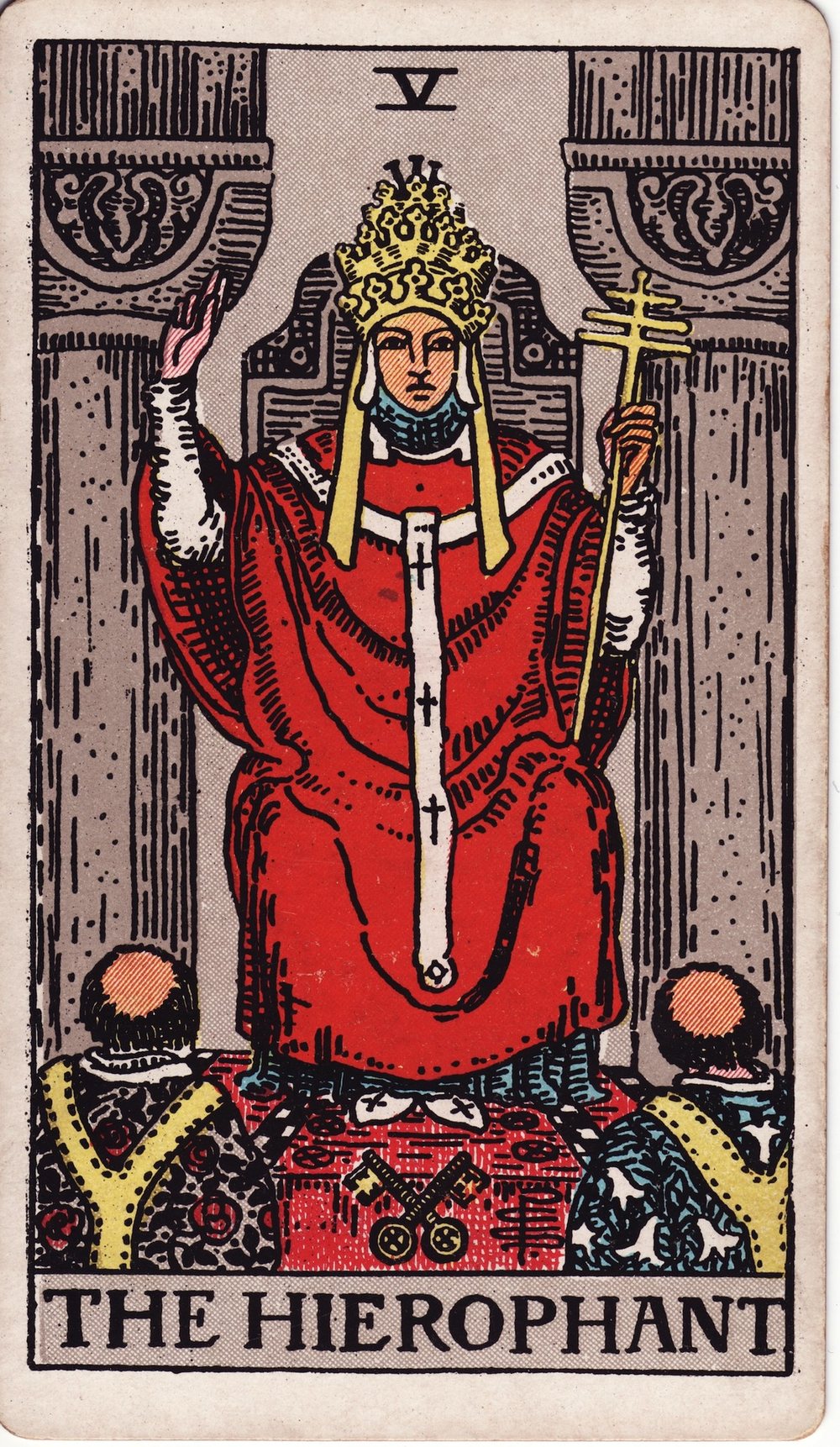
Look at the Rider-Waite image closely, because every inch of it is doing something. The Hierophant wears a triple crown, its three tiers representing the three worlds he mediates: the conscious, the subconscious, and the divine. His right hand is raised in blessing, two fingers pointing to heaven, two folded toward the earth, a gesture that says his whole job in one motion: I stand between what is revealed and what is hidden, and I pass one to the other. In his left hand he holds the triple-barred papal cross. His robe is red over white and blue, passion layered over purity and knowledge.
Before him kneel two tonsured monks. One wears a garment patterned with red roses, the other with white lilies: desire and thought, the two students every teacher receives. They are not groveling. They are learning. And at the Hierophant’s feet lie two crossed keys, gold and silver, sun and moon, the keys to the mysteries. Notice that he is not holding them. They sit out in the open, waiting for anyone willing to do the work of picking them up.
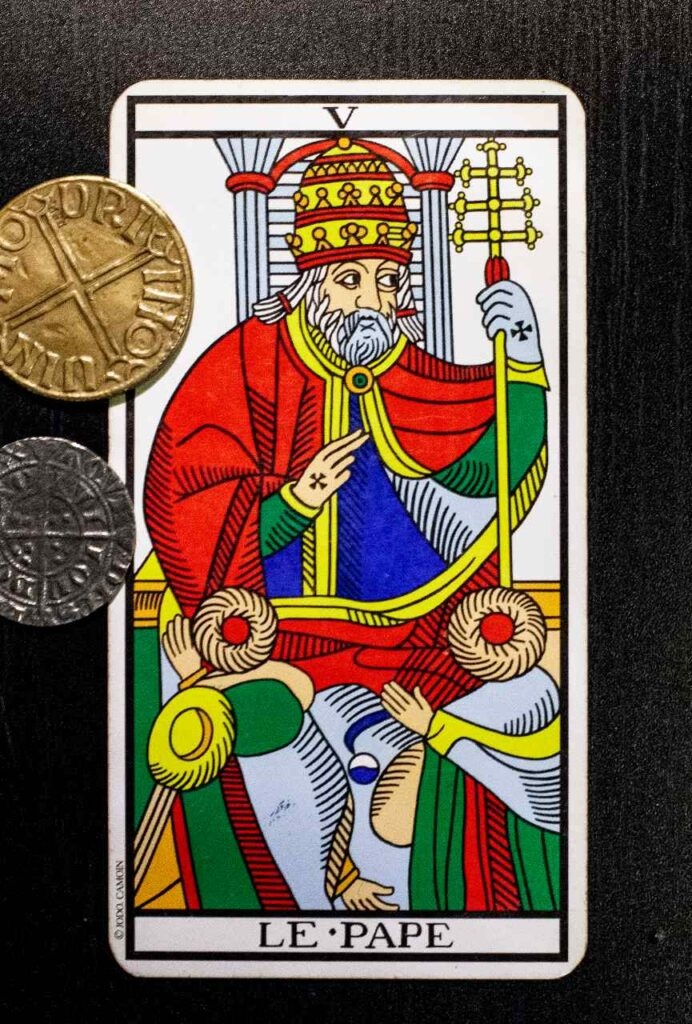
The word Hierophant comes from the Greek for “revealer of the sacred.” In the older Marseille decks he is simply The Pope, the counterpart to the High Priestess’s Papess. But where the High Priestess guards inner knowing behind her veil, the Hierophant takes sacred knowledge and teaches it out loud. She whispers. He explains.
He arrives right after the Emperor, and the sequence matters. The Emperor builds the walls and writes the laws. The Hierophant gives the structure a soul, a shared story, a reason people gather inside those walls on purpose. And directly after him come the Lovers, because only after you have learned the values of your culture can you make a genuine choice of your own.
Here is the plainest way to say it: the Hierophant is the reason you do not have to learn everything the hard way. Every recipe handed down, every apprenticeship, every wedding vow, every “let me show you how we do this” is his territory. Tradition, at its best, is just peer review with a longer timeline.
This guide covers every position and question the Hierophant is likely to meet.
What does The Hierophant Tarot card mean?
Upright, the Hierophant means structure, tradition, and guidance from a source that has earned its authority. It is the card of teachers, mentors, institutions, ceremonies, and the accumulated wisdom of people who walked your road before you and left notes.
Modern readers sometimes flinch at this card, because we live in an age that celebrates disruption and side hustles and figuring it out yourself from three videos and sheer nerve. The Hierophant raises a mild eyebrow at all of that. He is not against innovation. He simply knows what the two kneeling monks on the card know: you master the form before you improvise on it. Jazz musicians learn scales. Great chefs can make a mother sauce blindfolded. The rebel who changes everything usually understood the rules better than the people enforcing them.
When this card appears, some structure is calling you. It might be formal education, a certification, a mentor, a spiritual community, a twelve-week program, or simply a discipline you finally commit to instead of dabbling in. The invitation is to stop reinventing the wheel alone in your garage and go learn from the wheel-makers.
There is also a communal warmth here that people miss. The Hierophant presides over the moments when private feeling becomes public commitment: weddings, graduations, initiations, oaths. He is the card of standing up in front of witnesses and saying this matters enough to make it official.
He is not asking you to kneel. He is asking you to listen. There is a difference, and the whole card lives in it.
The Hierophant card Keywords:
- Tradition
- Guidance
- Mentorship
- Education
- Institutions
- Commitment
- Ceremony
- Shared values
- Spiritual wisdom
- Conformity
- Structure
- Belonging
- Apprenticeship
- Doing things properly
What does The Hierophant Tarot Card Mean when Reversed?
Reversed, the Hierophant is the moment the sermon stops making sense. The structure that once held you up starts to feel like it is holding you down, and you begin asking the dangerous, necessary question: do I actually believe this, or have I just never checked?
This is the card of dogma, rigid rules, hollow ritual, and authority that demands obedience it has stopped earning. It shows up when you are following a script written by your family, your church, your industry, or your feed, and some honest part of you has quietly stopped nodding along. It can also point to hypocrisy: the teacher who does not practice the teaching, the institution that protects itself instead of its people.
But read carefully, because the reversed Hierophant is not a permission slip for a tantrum. Reflexive rebellion is just obedience wearing a leather jacket; either way, someone else’s rules are still running your life. What this card actually calls for is discernment. Take your inherited beliefs down off the shelf one at a time and inspect them. Some will turn out to be load-bearing, and you will put them back with new respect. Others will crumble the moment you touch them, and you will wonder how long you carried dead weight.
Sometimes the reversal is gentler: an unconventional path that genuinely suits you. Eloping instead of the big wedding. Self-teaching instead of the degree. Building your own practice from parts. The card only asks that your departure from tradition be a real choice, made with open eyes, and not just a flinch.
The Hierophant card Reversed Keywords:
- Dogma
- Rebellion
- Questioning authority
- Hypocrisy
- Restriction
- Outdated rules
- Nonconformity
- Empty ritual
- Groupthink
- Breaking convention
- Personal beliefs
- Freethinking
- Stale structure
The Hierophant Tarot Card as How Someone (He/She) Sees You
When you ask the cards how another person sees you and the Hierophant answers, take it as a quiet compliment: they see you as the adult in the room.
To this person, you are steady, principled, and reassuringly consistent. You are the one they call when they need real advice rather than validation, the one whose opinion carries weight precisely because you do not hand it out cheaply. They may see you as a teacher figure even if you have never formally taught them anything, because you model something they are trying to learn: how to live by actual values instead of moods.
If the person you are asking about is not sitting across from you, it is worth knowing whether you can read for someone who is not present before you lean too hard on the answer.
There is a shadow to being seen this way, and you should know about it. People who see you as wise can forget you are also human. They may bring you their crises and never ask about yours, assuming your inner life is a tidy chapel that needs no visitors. Some may find you a touch conventional, the friend who is respected more than confided in, invited for counsel more than for chaos.
Still, in a world of hot takes and flaky plans, being seen as the person whose word means something is not a small thing. They see a keeper of standards. Most of them are grateful you exist.
The Hierophant Reversed as How Someone (He/She) Sees You
Reversed, the picture sours in one of two directions, and it is worth figuring out which.
The first: they see you as rigid. Preachy, even. In their eyes you have opinions about how everyone should live and insufficient hesitation about sharing them. Every conversation feels like a compliance review. They may feel judged by you before you have said a word, simply because your standards enter the room ahead of you. If several people in your life have gone quiet lately, consider whether your advice has been arriving unrequested and your approval has started to feel like a fee.
The second direction is the opposite: they see you as the rule-breaker. The heretic. The one who left the church, the company, the family script, and made everyone else’s staying feel suddenly like a choice they would have to defend. People can be strangely resentful of that. Your freedom reads as criticism of their fence.
Either way, the reversed Hierophant here describes a gap between your intentions and your reception. You think you are helping; they hear correcting. You think you are living honestly; they see showing off. You cannot fully control this, but you can soften it: ask more questions, issue fewer verdicts, and let people watch how you live instead of hearing about how they should.
What does The Hierophant Tarot Card mean in Love?
In a love reading, the Hierophant is one of the strongest commitment cards in the entire deck. Not the butterflies card. Not the stolen-glances card. The card of two people standing in front of everyone they know, saying vows out loud, and meaning them.
If you are in a relationship, this card points toward deepening formality: moving in, engagement, marriage, meeting the family, merging the practical machinery of two lives. It describes a bond built on shared values rather than shared adrenaline. You and this person agree about the load-bearing things: what money is for, what loyalty means, what a good life looks like on an ordinary Tuesday. That agreement is unglamorous and it is worth more than a thousand grand gestures, because passion has moods and values do not.
The Hierophant’s love is Taurus love: loyal, physical, patient, expressed less in poetry than in showing up, on time, again, for years. If you have been wondering whether this relationship is going somewhere serious, this card leans firmly toward yes, provided both of you actually want the destination and not just the momentum.
If you are single, the Hierophant suggests love may arrive through traditional channels: introduced by friends or family, met through a community, a class, a shared practice. It also asks you to know your own non-negotiables before you swipe. A clear look at where things stand is exactly what a good relationship tarot spread is for.
Fireworks fade. Foundations compound. The Hierophant is a foundations man.
What does the Hierophant Reversed mean in Love?
Reversed in love, the Hierophant asks an uncomfortable question: are you two in a relationship, or are you performing one?
This card appears when the outer form of commitment has outlived its inner content. The anniversaries are observed, the joint calendar hums along, the couple photo gets its yearly update, and somewhere under all that ceremony, two people have stopped actually choosing each other. Obligation has quietly replaced devotion, and everyone is too polite to mention it.
It also appears when outside expectations are steering the ship. The wedding is happening because the deposits are paid and the aunts have booked flights. The relationship persists because everyone in your circle has coupled off on schedule and being the exception feels like failure. If you are staying because leaving would require explanations, that is the reversed Hierophant, and he would like a word.
Sometimes the mismatch is about values themselves: one of you wants the traditional arc of rings and mortgages and children, and the other wants something unwritten. Neither desire is wrong. Pretending the gap is not there is what is wrong.
And sometimes, more happily, this card blesses an unconventional love that works: the couple who never marries and never wavers, the pairing nobody predicted and nobody can argue with. The reversed Hierophant only insists on one thing: build your relationship on what is true for the two of you, not on what photographs well for everyone else.
What does The Hierophant Tarot Card mean in Friendship?
In friendship, the Hierophant is the card of the old guard: the friends who have known you through several versions of yourself and hold the full archive.
These are relationships with rituals. The standing call. The annual trip that has survived jobs, moves, and at least one regrettable relationship each. The group chat with years of shared language in it, where a single word can carry a decade of context. The Hierophant honors exactly this kind of bond, the friendship that has become an institution in the best sense, with traditions worth keeping and a history that makes new friends feel like pleasant acquaintances by comparison.
This card can also point to a mentor hiding inside a friendship: the friend a chapter ahead of you in career, marriage, grief, or faith, whose example teaches you more than their advice does. If someone like that has been on your mind, the Hierophant suggests you stop admiring them from a distance and actually ask your questions. People who have walked the road are usually honored to be asked about it.
If your circle has been feeling thin lately, the Hierophant’s counsel is structural: join something. Communities with regular gatherings, shared purpose, and a bit of tradition are where durable friendships have always been manufactured. Friendship is not found so much as scheduled.
Tend the old bonds. Water what has roots.
What does the Hierophant Reversed mean in Friendship?
Reversed in friendship, the Hierophant describes a circle that has hardened into a club, complete with unwritten bylaws and a membership committee nobody elected.
You know the signs. There is a correct opinion on everything and a subtle chill for deviating from it. Someone plays high priest of the group, deciding what is cool, who is in, and which life choices get blessed. Loyalty gets measured in conformity: dress like us, vote like us, mock what we mock. The reversed Hierophant asks whether your friendships have room for the person you are becoming, or only for the person you were when you joined.
Outgrowing a friend group is one of adulthood’s least discussed griefs. Nothing dramatic happens. Nobody betrays anyone. You simply return from a gathering feeling smaller than when you arrived, and eventually you notice the pattern. This card gives you permission to notice it out loud.
It can also flag the reverse problem: you as the group’s enforcer. If a friend’s new path, new partner, or new belief has been receiving your quiet disapproval, ask yourself honestly whether they are actually in danger or merely off script. Those are different things, and only one of them is your business.
Real friendship survives divergence. If yours cannot, it was never friendship. It was uniformed agreement, and uniforms come off.
What does The Hierophant Tarot Card mean in Career?
In career readings, the Hierophant strongly favors the established path, and he is not embarrassed about it.
This is the card of institutions: universities, hospitals, law firms, school systems, government, banks, long-standing companies with actual pension plans. It shines on careers built through credentials, apprenticeship, and steady advancement. If you have been weighing whether to get the certification, take the training, join the professional body, or accept the role at the stable firm, the Hierophant votes yes. Structured expertise compounds. Every hour you spend learning from people who have already made the expensive mistakes is an hour you do not spend making them yourself.
Above all, this card says: find a mentor. Not a playlist of thought leaders. A person, with a name, who knows your work and will tell you the truth about it. One honest senior colleague reviewing your actual output is worth a hundred productivity essays. The two monks on the card are not watching a tutorial. They are in the room.
With money, the Hierophant is deeply, almost comically conservative, exactly as you would expect from a Taurus card. Proven vehicles, boring consistency, advice from an actual qualified human. He would sooner bless a modest index fund held for thirty years than any opportunity whose pitch includes the word “explosive.” If an investment requires you to hurry, the Hierophant has already left the meeting.
Trust the process. Better yet, find a process worth trusting, then actually follow it.
What does the Hierophant Reversed mean in Career?
Reversed in a career reading, the Hierophant is the sound of you sitting in a meeting, hearing “because that is how we have always done it,” and feeling something in your soul file a formal objection.
This card appears when the structure you work inside has stopped serving its purpose. The process exists to protect the process. Approval requires four signatures from people who will never read the document. Innovation is praised in the town hall and punished in the performance review. If your best ideas keep dying in committee while mediocrity ships on schedule, the reversed Hierophant confirms what you suspect: the problem is not you.
It can also mark a crisis of professional faith: the credential you spent years earning feels beside the point, the industry you trained for is not the one you are standing in, the ladder you have been climbing is leaning against the wrong wall. That vertigo is unpleasant and useful. Better to feel it now than at the retirement dinner.
A caution, though, because this card knows how quitting fantasies work: do not torch the stable job in a single glorious afternoon. The reversed Hierophant rewards deliberate heresy, not impulsive arson. Build the exit before you use it. Learn what the institution still has to teach you, take the pension match while you plan, and leave on your schedule rather than your frustration’s.
Question the rulebook, yes. But question it like a scholar, not a vandal.
The Hierophant Tarot Card as How Someone Thinks of You
When the Hierophant describes someone’s thoughts about you, the headline is respect. Deep, almost formal respect, the kind people usually reserve for teachers, elders, and the friend whose advice actually turned out to be right.
This person thinks of you as someone whose life has structural integrity. Your words and your actions match, and they have noticed, because that alignment is rarer than it should be. When they face a hard decision, there is a decent chance they run it past a small imagined version of you before they act. You may be a voice in their conscience without ever having applied for the position.
They may also think of you as the standard against which they measure their own choices, which is flattering and slightly heavy. To a romantic interest, this reads as marriage material: the person you plan around, not the person you merely enjoy. To a colleague, you are the one whose sign-off means the work is actually good. To a younger person in your orbit, you may loom larger than you realize, the way good teachers always do.
One gentle caution: respect can hold people at arm’s length. If you want their affection and not just their admiration, you may need to show them your unpolished parts on purpose. Pedestals are lonely at both ends.
The Hierophant Reversed as How Someone Thinks of You
Reversed, this card suggests the person’s thoughts about you have a complicated flavor, and authority is the complication.
They may think of you as rigid: the friend with a rule for everything, the family member whose visits require emotional preparation, the colleague who treats every preference as a policy. In their mind you have merged with the institutions you represent, and talking to you feels like talking to the manual. What you experience as having standards, they experience as being graded.
Alternatively, they may think of you as the one who broke the rules, and their feelings about that are tangled. Perhaps you left something they stayed in: the faith, the hometown, the company, the marriage script. Your existence quietly asks whether staying was a choice or a habit, and some part of them resents being asked. Envy wearing the costume of disapproval is still envy.
There is a third possibility worth naming: they doubt your sincerity. If you speak in ideals, they may privately wonder whether you live them, because they have been burned by preachers before. This is not necessarily fair to you. It is simply the tax the sincere pay for the hypocrites who came first.
In every version, the fix is the same: less proclaiming, more plain human presence. Let them meet the person behind the pulpit.
What does The Hierophant mean in Conflict?
In conflict, the Hierophant tells you to take the dispute out of the shouting match and into a structure. This is not the card of winning the argument. It is the card of finding the process that makes winning unnecessary.
Practically, that means channels. Mediation instead of ambush. The documented complaint instead of the hallway confrontation. The family meeting instead of the holiday eruption. A neutral third party both sides actually respect: a counselor, an arbiter, an elder, HR functioning as intended. The Hierophant knows something hard-won about human quarrels: two angry people negotiating alone tend to relitigate everything back to childhood, while a fair process and a referee keep the dispute the size it actually is.
Precedent matters here too. How have people resolved this before? What does the agreement, contract, or long-standing custom actually say? You may discover the fight has an answer already written down, waiting for someone calm enough to look it up.
The deeper move this card offers is to shift the argument from positions to values. Underneath most conflicts, both parties are defending something they consider sacred: fairness, loyalty, effort, respect. Name the values out loud and you often find more overlap than the yelling suggested.
Fight fair, fight formal, and let the process absorb the heat your relationship cannot afford to.
What does the Hierophant Reversed mean in Conflict?
Reversed in conflict, the Hierophant warns that the rules themselves have entered the fight, and not on the side of justice.
Watch for the person weaponizing procedure: the one who is technically correct and substantively wrong, hiding behind policy the way others hide behind lawyers. “I followed the process” can be an honest defense or a confession with good posture, and this card suggests the latter. If your dispute is being managed by someone whose loyalty runs to the institution rather than the truth, do not expect the official channel to save you. It was built by the people you are appealing against.
This card also flags conflicts with authority itself: the boss, the board, the parents, the committee. Understand what you are walking into. Institutions defend themselves reflexively, the way bodies fight infection, and they have more stamina than any individual. That does not mean stay silent. It means choose your battles like someone who intends to still be standing afterward. Documentation beats indignation. Allies beat volume. Timing beats passion.
And check your own hands for the same weapon. If you have been quoting rules at someone because the rules happen to favor you this week, you are the reversed Hierophant in this story, and the card is a mirror.
When the referee is compromised, stop playing for the referee. Play for the record, and for the exits.
The Hierophant Tarot Card as Feelings
As a feelings card, the Hierophant describes an emotion our culture barely has vocabulary for anymore: devotion. Not the flutter. The vow.
If you are asking how someone feels about you, this card says they are serious in an almost old-fashioned way. They do not just enjoy you; they respect you, and their feelings come with intentions attached. This is the person who thinks in terms of introducing you to their family, of years rather than weekends, of doing this properly. The feeling may not be loud. Taurus feelings rarely are. But it is the emotional equivalent of a stone building: unspectacular on a given day, and still standing after every storm that flattened flashier things.
If the card describes your own inner weather, you may be craving something to be devoted to. A faith, a practice, a person, a calling, anything sturdy enough to organize a life around. That hunger for reverence is not weakness or nostalgia. It is one of the oldest appetites humans have, and pretending to be too modern for it just leaves it unfed.
There can also be a feeling of being held by something larger: the steadiness that comes from belonging to a lineage, a community, a tradition that predates your problems and will outlast them.
Some feelings are weather. This one is climate.
The Hierophant Reversed as Feelings
Reversed as feelings, the Hierophant describes the ache of going through motions your heart has quietly left.
If you are asking about another person, be gently warned: they may be operating from duty rather than desire. They stay because staying is what one does, because the families are intertwined, because leaving would require a conversation they cannot face. The affection may not be gone, but it has been filed under obligation, and you can feel the difference even when you cannot prove it. You deserve to be chosen, not merely continued.
If the card describes your own feelings, it often marks a crisis of belief arriving on schedule. The faith you inherited fits strangely now. The values you were issued in childhood are due for an audit. Rituals that once moved you have become choreography. This is disorienting and it is not a malfunction. It is what growth feels like from the inside: the old container cracking before you can see the new one.
There may also be a specific, prickly feeling here: resentment toward someone who told you how to live. A parent, a church, a mentor whose guidance curdled into control. That anger is information. Let it identify the fence, and then decide, calmly and as an adult, which side of it you actually want to live on.
Honor what the old forms gave you. Then feel what you actually feel.
The Hierophant Tarot Card as a Situation
As a situation, the Hierophant means you are currently standing inside an institution’s machinery, and the situation will go better if you respect how the machinery works.
Concretely, this covers a recognizable family of scenarios: an application, an admission, a certification, a legal or bureaucratic process, a wedding and everything wedding-adjacent, a religious ceremony, a probation period at a new job, a formal review. Situations with gatekeepers, requirements, and correct procedures. The card’s counsel is unromantic and effective: learn the actual rules, meet the actual criteria, and show the institution the respect it believes it deserves. This is not the arena for improvisation. Nobody freestyles a mortgage application.
The Hierophant as a situation can also mean a teaching moment has arrived wearing work clothes. Whatever you are in the middle of is not just an event; it is a curriculum. Some lesson about patience, humility, or commitment is being offered, and the situation will keep reoffering it until you take the course.
There is often an elder or expert figure embedded in the circumstances: the advisor, the official, the seasoned hand whose cooperation changes everything. Find that person early and treat them well.
You are in a system. Systems reward those who learn them. Learn this one.
The Hierophant Reversed as a Situation
Reversed as a situation, the Hierophant means the system you are standing in is not working as advertised, and pretending otherwise is costing you.
This is red tape as a lifestyle: the approval that needs an approval, the office that only accepts forms it no longer prints, the policy that everyone agrees is absurd and no one has authority to change. If your situation feels like a maze designed by someone who hates mazes, the card confirms it. The dysfunction is structural, not personal. Stop taking the wall’s behavior personally.
It can also describe an institution actively failing its purpose: the school that stopped teaching, the workplace where values live only in the onboarding deck, the community whose warmth turned out to be conditional on your compliance. Discovering this hurts in a specific way, because you did the trusting the structure asked of you. The reversed Hierophant validates the disillusionment and then asks the practical question: given what you now know, what is your move?
Sometimes the move is internal reform, and sometimes it is the door. This card grants full permission for the door.
One more possibility: the situation is unconventional by design, and that is its strength. A nontraditional arrangement, an unorthodox path that suits everyone involved. If it works and it is honest, it does not need the committee’s blessing.
The Hierophant Tarot Card as Intentions / What Someone Wants
When the Hierophant represents someone’s intentions toward you, the word you are looking for is legitimacy. This person wants to make it official.
In romance, these are the intentions your grandmother would approve of: commitment, exclusivity, the meeting of families, possibly the ring. This is not someone auditioning options or keeping things breezy on purpose. They are thinking in terms of building something with you, and they want the structure that protects what gets built: definitions, promises, a shared future stated out loud. If you have been wondering whether they are serious, the Hierophant answers plainly. They are the kind of serious that comes with paperwork.
In work or business, this person wants a formal arrangement: the contract, the partnership, the defined role. They want things proper and documented, which is usually excellent news, since people who insist on clear terms tend to be people who intend to honor them.
There can also be a teaching intention here: someone wants to guide you, pass something on, take you under a wing. Received from a good heart, this is one of life’s quiet gifts.
One honest caveat: the Hierophant wants commitment, and occasionally wants the form of it more than the substance. Make sure they are devoted to you, and not merely to being settled. The difference emerges in how curious they stay about who you actually are.
The Hierophant Reversed as Intentions / What Someone Wants
Reversed, the Hierophant’s intentions grow murkier, and they usually cluster around control, appearances, or escape.
Control looks like this: they want you to fit a template. They have a settled vision of how a partner, employee, or family member should behave, and their project is your gradual renovation toward it. The affection may be real, but it is conditional on compliance, and you can feel the conditions even when they are never spoken. Watch for correction disguised as care, and for how they respond the first time you decline to be improved.
Appearances look like this: they want the optics of commitment without its weight. The relationship that photographs well and goes nowhere. The business partner who loves the announcement and vanishes before the work. For them, the ceremony is the point; the vow is set dressing. Their calendar will tell you the truth their speeches will not.
Escape looks like this, and it is the most sympathetic: they are chafing against structures of their own and want out of a script, possibly one that includes you through no fault of yours. Their restlessness is real but unaimed, and unaimed restlessness makes messy exits.
In all three cases the advice converges: slow down, ask direct questions about what they actually want, and weigh the answers against their behavior. Intentions this tangled rarely untangle on your timeline.
Is The Hierophant a Yes or a No?
The Hierophant is a yes, delivered in the tone of a wise advisor rather than a cheerleader: yes, if you do it properly.
For questions about marriage, commitment, education, certifications, joining an institution, or taking the established route, this card is one of the most reliable yeses in the deck. It especially favors anything involving vows, study, mentorship, or long-term building. Asking whether to commit to the person, the program, or the practice? Yes. Asking whether the traditional path is worth it even though it is slower? Emphatically yes.
The yes comes with conditions, though, and the Hierophant would consider it dishonest to hide them. His yes assumes you will follow the process, respect the requirements, and put in the unglamorous hours. This is a yes to the whole apprenticeship, not to the shortcut. If your question secretly means “can I get the reward without the discipline,” then the honest reading is no, and you already knew that.
Reversed, the Hierophant leans no, or more precisely: not this way. The conventional route fails you here, the authority you are deferring to is wrong, or the commitment under consideration would be made for appearances rather than truth. Rethink the approach before you rethink the goal.
If a bare yes or no feels too thin for what you are carrying, one of the best tarot spreads for guidance will give the question the room it deserves.
The Hierophant Tarot Card as a Place
As a place, the Hierophant is anywhere the ceiling makes you lower your voice.
Churches, temples, cathedrals, and chapels, obviously: he is enthroned in one on the card itself, grey pillars rising behind him. But his territory extends to every building organized around transmitted knowledge and shared reverence. Universities with their lecture halls and worn stone steps. Libraries where the silence is doctrinal. Courthouses, parliaments, banks from the era when banks were built to look eternal. Museums. Monasteries. The exam hall. Any room where an oath has ever been administered.
He also presides over humbler sanctuaries of tradition: the grandparents’ house where the recipes and the rules live, the family table at the holiday meal, the old barbershop, the lodge hall, the dojo with decades of belts on the wall. What unites all Hierophant places is continuity. People gathered here before you were born, doing roughly what you are doing now, and the room remembers.
If the card is pointing you somewhere, it points toward these: go where the old knowledge is kept. Study in the library rather than the app. Have the hard conversation in the family home. Sit in a sacred building even if you are unsure what you believe, and notice what the architecture does to your thinking.
Some walls hold you up. This card knows the address.
The Hierophant Reversed as a Place
Reversed as a place, the Hierophant describes institutional space gone wrong: rooms where the structure remains but the spirit has moved out.
Picture the abandoned church with pigeons in the rafters, the shuttered school, the office where the mission statement peels off the wall above people quietly updating their resumes. Places of empty ceremony: the venue where the ritual happens on schedule and means nothing to anyone performing it. Bureaucratic purgatories, the waiting rooms and permit offices where time is a fee everyone pays. If a place makes you feel processed rather than welcomed, it belongs to this card.
More pointedly, the reversed Hierophant can mark places of control: communities, campuses, workplaces, or congregations where belonging is priced in conformity and the exits are subtly discouraged. The architecture of these places can be beautiful. The chill is in the customs, not the stonework. Trust the part of you that keeps checking where the door is.
For your own life, this card may be naming a specific location you have outgrown: the hometown that fits like an old uniform, the family house where you revert to age fourteen upon entry, the institution you keep visiting out of loyalty to who you used to be there.
You are allowed to love a place and still leave it. Buildings do not grieve. People just imagine they do.
The Hierophant Tarot Card as an Obstacle / Challenge
As an obstacle, the Hierophant means the thing standing in your way has a rulebook, a gate, and probably a waiting list.
Sometimes the obstacle is literal gatekeeping: the credential you lack, the license you must earn, the board that must approve, the required years of experience for the job that would give you the experience. These barriers are tedious and mostly non-negotiable. The card’s advice is unsentimental: stop arguing with the gate and start meeting its requirements. Institutions do not care that you are a special case. Every gate believes it has seen every special case.
Sometimes the obstacle is tradition itself: family expectations with the density of law, a culture whose script has no scene for what you are trying to do, the collective weight of “we do not do that here.” Fighting this head-on exhausts most people. The wiser route is usually quieter: build your proof, keep your respect for the people even when you decline their template, and let results argue on your behalf.
And sometimes, be honest, the obstacle is the Hierophant inside you: the internalized rule-follower who needs permission for everything, who will not start until some authority signs off. No committee is coming to approve your life. That signature was always yours to write.
Name which gate you are facing, the world’s or your own. They open differently.
The Hierophant Reversed as an Obstacle / Challenge
Reversed as an obstacle, the Hierophant flips the problem: what stands in your way is not too much respect for structure but too little, or the wrong kind entirely.
Look first at reflexive contrarianism. If your identity is built around not doing what everyone else does, that is still a rulebook; it just prints everything in reverse. The person who cannot take advice, cannot follow a proven method, cannot submit to any teacher because submission feels like defeat, ends up hand-carving mistakes that a mentor could have retired for them decades ago. Pride in learning nothing from predecessors is not independence. It is expensive theater.
The obstacle may also be a corrupted authority you have not yet stopped obeying: the outdated advice you still follow because a parent installed it, the industry dogma everyone repeats and nobody tests, the mentor whose guidance quietly became about their needs. Ask which voices in your head still hold offices they should have vacated.
Or the challenge is disillusionment itself: an institution burned you, and now you distrust all structure on principle, refusing the church because of the scandal, the job because of the last job, commitment because of the last commitment. Understandable. Also paralyzing. One corrupt referee does not abolish the game.
The work here is rebuilding discernment: neither kneeling to every authority nor spitting at all of them, but learning, case by case, which ones have earned your trust.
The Hierophant Tarot Card as Action
As an action card, the Hierophant is refreshingly specific: go find the people who already know, and formally put yourself in their path.
Enroll. Sign up for the course, the program, the training that you have been circling for months. Not the someday version. The one with a start date and your name on the roster, because the Hierophant knows that commitment without structure evaporates, and structure without commitment was never yours to begin with.
Ask for mentorship, in actual words. Identify the person whose path you respect and request their guidance directly: an hour, a coffee, a look at your work. People underuse this move because it requires admitting they are a student. The two monks on the card are not embarrassed to kneel and learn. That humility is the price of the keys lying at the Hierophant’s feet, and it is the bargain of a lifetime.
Formalize what you have been keeping casual. Make the proposal. Put the partnership in writing. Say the commitment out loud in front of witnesses. Informality feels safe because nothing official can fail, but nothing official can fully live, either.
And commit to a practice with rules you did not invent: the tradition, the discipline, the training program followed as written. Do it daily, especially when uninspired. Inspiration is lovely. Attendance is transformative.
Stop researching. Start apprenticing.
The Hierophant Reversed as Action
Reversed as action, the Hierophant tells you to respectfully close the manual and act on your own considered judgment.
Get the second opinion. Whatever the authority in your situation has decreed, from the doctor, the boss, the advisor, the expert in the family, verify it independently before you build your life on it. Authorities are often right, which is how the wrong ones stay credible. The reversed Hierophant does not say distrust everyone. It says confirm, then trust.
Customize the path. Take the established method and modify it openly for your actual circumstances: the career built sideways instead of up the ladder, the education assembled from unaccredited pieces, the ceremony rewritten so the vows are in your own words. The tradition was made by people solving their problems. You are allowed to be a person solving yours.
Leave, if leaving is overdue, and leave well. Exit the institution, the congregation, the committee, the arrangement that you have already left in spirit. Do it with a letter rather than a bonfire: state your reasons, thank what deserves thanks, and keep your dignity as you go. Burned bridges illuminate nothing but your own retreat.
And say the heresy out loud, at least once, to someone safe. “I do not think I believe this anymore” is a sentence that costs a great deal and buys back your whole inner life.
Break the rule you have outgrown. Break it awake, on purpose, and sign your name to it.
The Hierophant Tarot Card as Advice
As advice, the Hierophant offers the most unfashionable counsel in the modern world: do not reinvent the wheel. The wheel is fine. Learn the wheel.
Whatever you are facing, someone has faced it before you and left records: books, teachers, traditions, protocols, elders, entire institutions built from the compressed trial and error of generations. The Hierophant advises you to consume that inheritance before you improvise. Take the established course before designing your own. Ask the veteran before trusting the search results. Follow the recipe exactly once before you start substituting. Your originality will survive the discipline; in fact, it will finally have something to stand on.
He also counsels commitment over sampling. We live in an era of infinite browsing: of practices tried for nine days, of faiths window-shopped, of relationships kept in the cart. The Hierophant’s advice is to pick something worthy and go deep. Depth is where all the value was hiding while you were skimming. The person who does one discipline for ten years holds keys the dabbler cannot even see.
And he advises reverence, in whatever form is honest for you. Keep something sacred: a practice, a day, a table, a promise. A life with nothing sacred in it is all lobby and no sanctuary.
Honor the process. The process is older than your impatience, and it will outlast it.
The Hierophant Reversed as Advice
Reversed as advice, the Hierophant says: the conventional answer is wrong for you this time, and deep down you have already voted.
Trust your conscience over the consensus. When the official guidance, the family verdict, and the culturally approved next step all point one way, and something steady in you keeps pointing the other, this card sides with the something. Not with your impulses, note. With your conscience: the quiet, consistent knowing that survives your moods and has been repeating itself politely for months. Learn to tell those two voices apart, because only one of them deserves the deciding vote.
Audit your inherited beliefs like an adult reviewing an old subscription list. You are almost certainly still paying for convictions you never chose: about money, God, gender, success, what a proper life looks like by which birthday. Cancel the ones that lapsed years ago. Keep the ones that still earn their place. The point is not rebellion. The point is that your beliefs should be yours on purpose.
If a structure in your life demands conformity as the price of belonging, the advice is to decline the deal, kindly and completely. Anything that requires you to shrink is not community. It is containment with refreshments.
The rules were made by people no wiser than you, doing their best in their time. Do your best in yours. That is the whole tradition, honestly kept.
The Hierophant Tarot Card as an Outcome
As an outcome, the Hierophant promises that this ends in something official, blessed, and built to last.
Depending on your question, the concrete forms are recognizable: the marriage, the acceptance letter, the granted certification, the closed deal with signatures on it, the welcome into the community or institution you have been courting. Whatever has been informal, probationary, or pending resolves into recognized standing. You stop auditioning and become a member. There is a particular relief in this kind of ending, the relief of a thing settled properly, with witnesses.
The outcome also carries a quality, not just an event: legitimacy. What you have built will rest on solid ground: shared values, honest process, foundations poured slowly and correctly. This is not the fireworks ending. It is the certificate-on-the-wall, ring-on-the-hand, name-on-the-door ending, and it holds weather that flashier outcomes cannot.
Expect the timeline to be Taurus-paced. Institutions do not hurry, and neither does anything worth an oath. The Hierophant’s outcomes arrive after the full process has run: the banns read, the requirements met, the probation served. If you are mid-process now, this card is telling you the slow machinery is actually working, however motionless it looks from inside.
One quiet condition: the blessing lands only if the commitment is real. The Hierophant seals true vows. If yours are still half-meant, finish meaning them before the ceremony, whatever your ceremony is.
The Hierophant Reversed as an Outcome
Reversed as an outcome, the Hierophant means this resolves outside the approved script, and the ending will be honest even if it is not applauded.
In practical terms: the engagement that is called off rather than completed, the program left before graduation, the resignation from the institution, the departure from the faith, the deal that dies in legal review. Something that was headed toward official status swerves. Before you grieve, look closely at what exactly is being lost. Often the reversed Hierophant cancels a ceremony that had already lost its meaning, and the real loss happened quietly, months earlier. The outcome merely files the paperwork on a truth everyone knew.
Alternatively, the ending is unconventional and genuinely good: the couple that builds a devoted life without the license, the career that flourishes with no credential behind it, the self-made structure that outperforms the sanctioned one. Approval and success were never the same thing; this outcome is where you prove it.
There is sometimes a third version: exposure. A hypocrisy comes to light, an authority is discredited, an institution’s failure becomes public. If you have been gaslit by a structure, this outcome is your vindication arriving late but signed.
What this card will not deliver is the traditional stamp. If you needed the world’s notarized blessing, mourn that briefly. Then notice how much lighter the unblessed path packs.
The Hierophant Tarot Card in the Future
In the future position, the Hierophant announces that a structured chapter is approaching: a season of study, commitment, and formalization that will give your currently loose ends somewhere permanent to attach.
Concretely, watch for these arriving on the horizon: a return to learning, whether a degree, a training, or an apprenticeship under someone excellent. A deepening commitment heading toward ceremony: the engagement, the vows, the formal partnership. An entry into an institution or community that will shape you: a new employer with real culture, a spiritual home, a professional guild. A mentor who has not appeared yet but will, probably through a door you are about to walk through for unrelated reasons. Say yes to the invitation that involves showing up regularly.
The tone of this coming chapter matters as much as its events. After whatever looseness or drifting has characterized the recent past, life is about to acquire rhythm: schedules, obligations, standards, belonging. Some part of you may brace at that. Another part, likely the part that prompted this reading, has been starving for exactly it. Structure is not the opposite of freedom. It is the thing freedom stands on once it tires of floating.
Prepare like a student expecting a good teacher: humble, curious, with your excuses pre-retired.
What is coming will ask for your commitment. Have it ready.
The Hierophant Reversed in the Future
Reversed in the future position, the Hierophant forecasts a crisis of belief on its way, and it will be one of the most useful disruptions of your life, provided you do not waste it.
Something you currently trust is going to come up for review: an institution that will disappoint you, an authority whose feet of clay will become visible, a tradition whose script will suddenly stop fitting the scene you are living. This is not a punishment. It is a scheduled renovation. Every examined life eventually molts its inherited certainties, and your molt has a date.
Practical shapes this might take: a falling-out with a structure you belong to, a job or field whose orthodoxies you can no longer recite with a straight face, a family expectation you finally decline, a formal path abandoned midway for a truer one. There may be a period of unaffiliated wandering between the old framework and whatever you build next. Budget for that gap. It is roomier than it is comfortable.
The card’s preparation advice: start strengthening your inner authority now. Practice making small decisions without polling anyone. Notice which of your beliefs you can actually defend and which you have only ever repeated. When the external framework wobbles, people with an internal one barely stumble.
The future is asking you to graduate from being told to knowing. Commencement is closer than you think.
The Hierophant Tarot Card as a Person
As a person, the Hierophant is the one whose advice you quote for the rest of your life, sometimes without remembering where you got it.
Picture them: the teacher who took your potential personally. The grandfather who says little and is always right. The family doctor, the priest or rabbi or imam, the professor emerita, the master tradesman who makes apprentices redo the joint until it is honest. The accountant who has seen every kind of foolishness and gently steers you past yours. This person carries transmitted knowledge: not just what they figured out, but what was handed to them, tested across generations, and handed on. Talking to them feels like consulting a library that loves you.
Temperamentally, expect Taurus: steady, unhurried, loyal to a fault, fond of ritual and quality, resistant to fads with an almost athletic stubbornness. They keep their word so reliably that their word functions as currency. They will not chase you with their wisdom; like the crossed keys on the card, it lies available, waiting for you to ask properly.
Their flaw, and they have one, is inflexibility. The same conviction that makes them a lighthouse can make them slow to accept that the coastline changed. Bring them your respect and your own judgment both.
If you have such a person, this card is your reminder: ask your questions while they are still here to answer.
The Hierophant Reversed as a Person
Reversed as a person, the Hierophant comes in two editions, and telling them apart quickly will save you real grief.
The first is the false authority: the one with the title, the pulpit, or the corner office, and none of the wisdom the position implies. They enforce rules they exempt themselves from, quote the tradition selectively when it serves them, and treat questions as insubordination because questions are the one test they cannot pass. At their mildest, this is the dogmatic uncle with a verdict on your life choices. At their worst, this is the leader whose institution exists to protect them, the mentor whose guidance somehow always increases your dependence, the expert threatened by your growth. The tell is consistent: genuine authorities want you to eventually surpass them; false ones need you kneeling permanently. Watch how they react the day you stand up.
The second edition is far better company: the honest heretic. The one who left, the freethinker, the person who studied the tradition deeply enough to earn their disagreements with it. They can be prickly and allergic to groups, and their contrarianism sometimes fires at random. But their doubts are load-tested, their respect must be earned rather than performed, and they will tell you truths the officiants cannot afford to. If this person is in your life, keep them. Every believer needs one friend who checks the math.
One demands your obedience. The other sharpens your freedom. Learn the difference by heart.

What Zodiac Sign is The Hierophant?
The Hierophant belongs to Taurus, the fixed earth sign ruled by Venus, and once you see the pairing, you cannot unsee it.
Taurus is the zodiac’s great keeper. Where other signs chase the new, Taurus asks the older, sturdier question: what is worth keeping? It governs the second house of values and possessions, and its genius is endurance: the practice maintained for decades, the promise kept without fanfare, the same path walked daily until it becomes a road others can follow. That is the Hierophant’s entire method. Tradition is simply Taurus energy operating across generations, value tested by time until it hardens into heritage.
The Venus rulership explains the card’s warmth, which colder readings miss. This is not tradition as punishment. Venus loves beauty, comfort, and devotion, and the Hierophant’s world is full of all three: the candlelit ceremony, the anniversary meal, the ritual meaningful precisely because it is repeated. Taurus does not keep traditions out of fear. It keeps them out of love, the way you keep a grandmother’s ring.
The fixed earth element supplies the card’s stubbornness, both virtues and vices included: unmatched steadiness, and a certain slowness to admit when a cherished structure has stopped serving.
If a Taurus features in your life, this card may literally point to them: the loyal, sensual, immovable friend who was right about the long game.
Final Thoughts
The Hierophant is the deck’s great argument that you do not have to start from zero, that the accumulated wisdom of everyone who came before you is not a cage but an inheritance, and that the keys to it are lying in plain sight at his feet for anyone humble enough to pick them up. Upright, he sends you toward teachers, traditions, and commitments made out loud. Reversed, he hands you the harder assignment of sorting living wisdom from dead rules and signing your own name to your beliefs.
His placement in the Major Arcana tells the deeper story. He inherits the ordered world of the Emperor and prepares you for the great personal choice of the Lovers, because you can only truly choose your values after someone has taught you what values are. And he forever faces his silent counterpart, the High Priestess, the two of them holding the same knowledge, one behind the veil and one at the pulpit.
Learn the tradition. Question the tradition. In that exact order, and with respect at both steps. That has always been the whole curriculum, and the Hierophant has never once hurried a student through it.